

The Blueprint of Enterprise Automation: Designing and Constructing Advanced AI Agents
The paradigm of digital transformation has officially shifted. Standard rule-based automation pipelines and passive chatbots are no longer sufficient to sustain a competitive edge in fast-evolving markets. Modern operational efficiency requires proactivity, adaptive decision-making, and structural autonomy.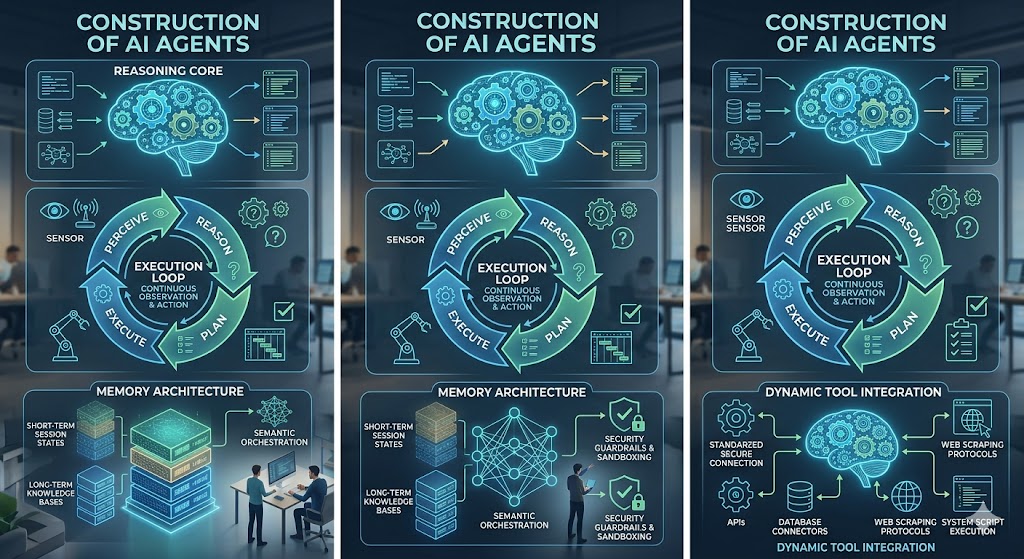
The construction of Autonomous AI Agents bridges the gap between passive large language models (LLMs) and fully integrated corporate operational layers. When properly architected, an AI agent operates within a continuous loop of perception, reasoning, planning, and action, transforming abstract strategic goals into concrete operational results.
Core Pillars of AI Agent Architecture
Building a production-grade AI agent requires moving past basic system prompting. True agentic capability emerges from a cohesive infrastructure that seamlessly integrates reasoning engines with persistent operational layers.
- The Reasoning Core: Leveraging advanced foundation models to handle task decomposition, contextual interpretation, and strategic decision-making under uncertainty.
- Memory Architecture: Utilizing a multi-tiered memory system to store short-term session states, long-term interaction histories, and semantic organizational knowledge bases.
- Dynamic Tool Integration: Equipping the core engine with secure operational capabilities, including APIs, database connectors, standard web scraping protocols, and system-level script processing.
- The Action Loop: Running a continuous cycle of evaluation and correction where the agent observes the output of its actions, updates its state, and refines its next step until the objective is achieved.
The Tactical Guide to Constructing Enterprise-Grade Agents
Successfully deploying an autonomous agent into an enterprise ecosystem demands a rigorous, phase-based engineering approach to ensure reliability, predictability, and data safety.
1. Defining the Operational Boundary and Goal Intake
- Objective Quantification: Define explicit, measurable goals for the agent rather than open-ended instructions. The target system must translate abstract objectives into concrete performance parameters.
- Guardrail Mapping: Establish strict operational boundaries, data-access limitations, and deterministic constraints before writing any underlying orchestration code.
2. Implementing Stateful Orchestration Frameworks
- Graph-Based Control: Utilize mature, production-proven orchestration frameworks to build explicit, stateful, and controllable agentic workflows that prevent loops or infinite operational trails.
- Multi-Agent Systems: For intricate enterprise workflows, decouple responsibilities by constructing role-based multi-agent networks where specialized agents collaborate via structured protocols.
3. Establishing Model Context Protocol (MCP) and Tool Governance
- Standardized Integration: Adopt universal integration protocols to connect your reasoning core to enterprise databases, internal content repositories, and external communication networks securely.
- Secure Sandbox Environments: Isolate all code-processing activities or file-system manipulations within ephemeral, secure sandboxes to protect core infrastructure from unintended computational errors.
4. Setting Up Observability and Tracing Pipelines
- Span-Level Tracking: Instrument the entire agentic architecture with real-time tracking pipelines to monitor individual LLM calls, tool processing latencies, and state transitions.
- Continuous Evaluation: Implement automated evaluation frameworks to score task completion rates, tool accuracy, and factual alignment across complex multi-step operational traces.
Architectural Trade-offs in Agent Deployment Modes
Selecting the optimal deployment infrastructure dictates the scalability, cost efficiency, and real-time latency profiles of your autonomous systems.
| Deployment Model | Primary Focus | State Management | Ideal Use Case |
| Stateless HTTP Endpoint | Minimal resource footprint | Externalized database storage | High-frequency, short-turn transactional workflows |
| Queue-Based Runtime | High durability and resilience | Persistent checkpoint stores | Long-running, multi-step asynchronous operations |
| Serverless Architecture | On-demand scale optimization | Managed cloud state layers | Spiky, unpredictable enterprise workloads |
Enterprise Safeguards and Risk Management
Operating autonomous decision-making engines within corporate environments requires zero-trust security postures and absolute compliance with international data privacy frameworks.
- Human-in-the-Loop (HITL) Interventions: Integrate mandatory human review and approval gates for high-stakes operational steps, including financial ledger changes, code deployment, or direct customer communication.
- Data Residency and Privacy Controls: Enforce strict data-handling policies ensuring that sensitive interaction histories, vector embeddings, and trace logs comply fully with regional data protection standards.
- Zero-Trust Token Governance: Ensure every external tool call and data retrieval process utilizes scoped, audited, and strictly limited access tokens to eliminate the risk of privilege escalation.
Legal and Operational Disclaimer
The information presented in this article is intended strictly for educational, strategic, and informational purposes. The design, construction, and deployment of autonomous AI agents involve complex technical, architectural, and security considerations. Absolute success, software reliability, or specific return on investment (ROI) metric outcomes are not guaranteed by adopting these frameworks. Organizations must independently validate all code architectures, ensure compliance with localized legal regulations, and perform comprehensive penetration and vulnerability testing prior to deploying autonomous agents into live production environments.
Related Articles
Navigating the Internet Landscape for Seniors: Essential Tips and Insights
Jun 2, 2026 at 5:53 AM
Navigating Senior-Friendly Internet Options
Jun 2, 2026 at 5:55 AM
AI Video Generator: The Future of Effortless Video Creation
Oct 23, 2025 at 7:26 AM
Technology and the Internet of Things (IoT)
Apr 30, 2026 at 9:28 AM
Technology and Health: Applications and Developments
Apr 30, 2026 at 9:24 AM
Technology and Cloud Computing
Apr 30, 2026 at 9:27 AM
Technology and Human Behavior
Apr 30, 2026 at 9:22 AM
Technology and Transportation Systems
Apr 30, 2026 at 9:25 AM
Emerging Technologies and Their Potential Implications
Apr 30, 2026 at 9:19 AM
Technology and Artificial Intelligence: Concepts and Applications
Apr 30, 2026 at 9:27 AM
Technology and Innovation: Processes and Drivers
Apr 30, 2026 at 9:21 AM
The Impact of Technology on Communication and Human Interaction
Apr 30, 2026 at 9:17 AM
Generative AI Tools in Business Transformation: Driving Innovation and Efficiency
Feb 5, 2025 at 3:20 AM
Technology and Globalization
Apr 30, 2026 at 9:23 AM
Technology and Digital Infrastructure
Apr 30, 2026 at 9:21 AM
Helpdesk Ticketing Systems: Definition, Features, Benefits, Acquisition, and Learning Resources
Jun 20, 2025 at 7:45 AM
Technology and Environmental Sustainability
Apr 30, 2026 at 9:20 AM
Technology and Blockchain Systems
Apr 30, 2026 at 9:29 AM
The Role of Technology in Modern Society
Apr 30, 2026 at 9:16 AM
AI-Driven Short Video Content Creation
Dec 3, 2025 at 6:49 AM
Guía de herramientas de creación de contenido con IA: de lo básico a la práctica
Dec 5, 2025 at 10:17 AM
Technology and Automation in Everyday Life
Apr 30, 2026 at 9:20 AM
Technology and Information Access
Apr 30, 2026 at 9:26 AM
Transform Your Workforce with a Corporate LMS
Jul 14, 2025 at 9:44 AM
Technology and Data: Collection, Use, and Interpretation
Apr 30, 2026 at 9:19 AM
The Development of Technology and Its Historical Context
Apr 30, 2026 at 9:17 AM
Unmatched Internet: Exclusive Internet Solutions for a Seamless Experience
Jan 9, 2025 at 9:28 AM
What Is a Portable Oxygen Concentrator — And Why Some People Shop Online
Dec 2, 2025 at 10:25 AM
Technology in Education: Opportunities and Considerations
Apr 30, 2026 at 9:18 AM
Technology and Security: Systems, Risks, and Protection
Apr 30, 2026 at 9:24 AM


This website only serves as an information collection platform and does not provide related services. All content provided on the website comes from third-party public sources.Always seek the advice of a qualified professional in relation to any specific problem or issue. The information provided on this site is provided "as it is" without warranty of any kind, either express or implied, including but not limited to the implied warranties of merchantability, fitness for a particular purpose, or non-infringement. The owners and operators of this site are not liable for any damages whatsoever arising out of or in connection with the use of this site or the information contained herein.