

All-on-4 Dental Implants: What to Know About Full‑Arch Solution
What Are All-on-4 Implants?
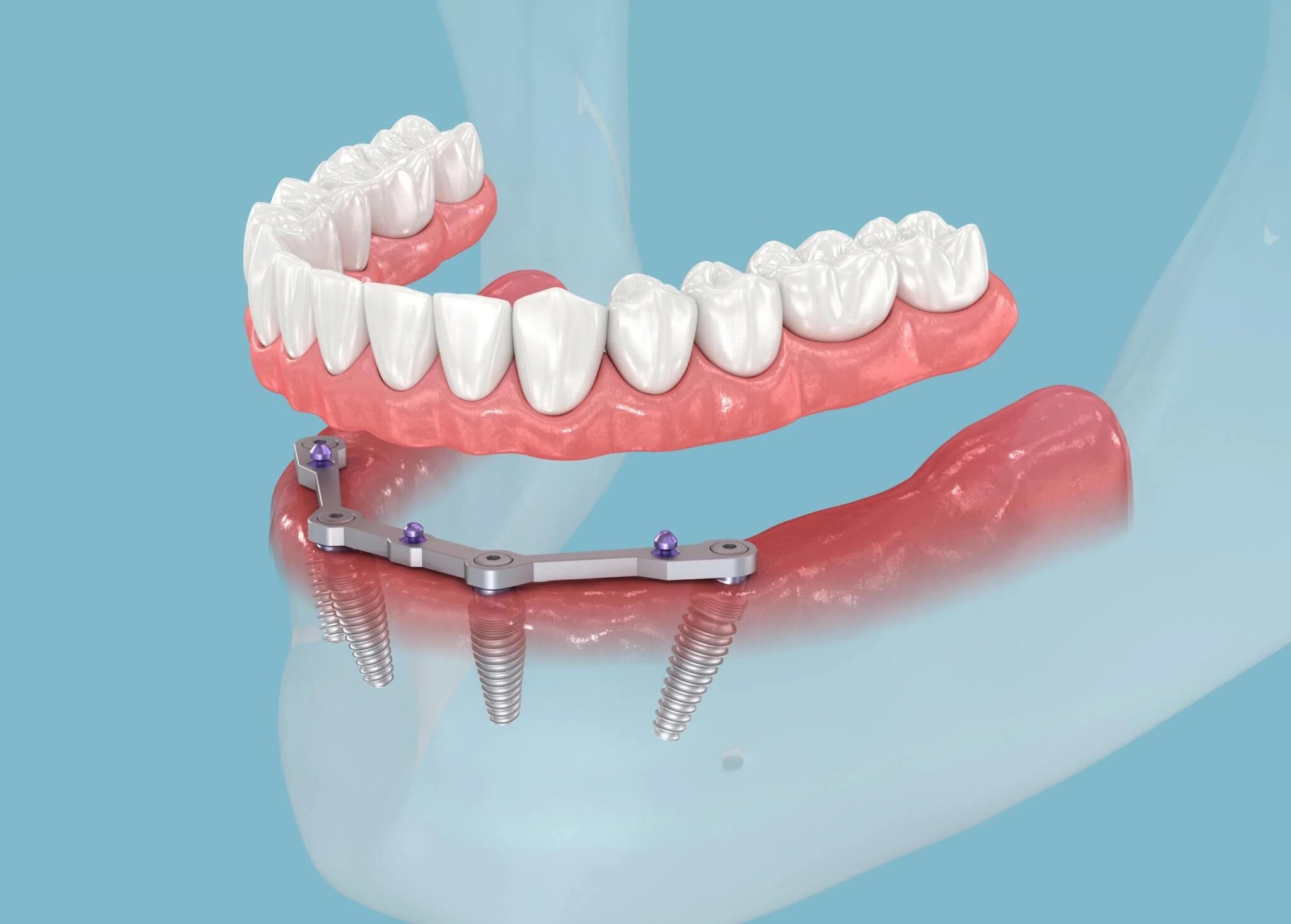
All‑on‑4 dental implants are a method for restoring a full upper or lower jaw when many or all teeth are missing or failing. The concept uses four implants per jaw to support a fixed, full-arch prosthesis (a bridge) rather than relying on a large number of individual implants or removable dentures. Two implants are placed in the front (vertical) and two angled in the back — this angled placement helps make the most of available bone, often avoiding more invasive bone‑grafting procedures.
The result is a prosthesis that is fixed (non-removable by the patient), designed to function and feel more like natural teeth than typical dentures.
How the All‑on-4 Procedure Typically Works
Here’s a common workflow for an All‑on‑4 treatment:
- Planning and Imaging: Before surgery, advanced imaging (such as a CT scan) helps map bone volume and vital structures (nerves, sinuses). This enables a precise surgical plan.
- Extraction (if needed) & Implant Placement: Any failing teeth are removed. Then the four implants are placed according to the plan — two vertical in front, two angled in the back.
- Immediate Temporary Prosthesis (“Teeth in a Day”): Often, a temporary fixed bridge is attached the same day, allowing the patient to walk out with functional teeth.
- Healing and Osseointegration: Over the next several months, the implants fuse with the jawbone (osseointegration), creating a stable foundation.
- Final Prosthesis: After healing, a permanent bridge is crafted — from materials like acrylic, metal‑ceramic, or zirconia — and attached, replacing the temporary one.
Why All-on-4 Is Often Chosen Over Other Solutions
Compared to traditional dentures or full-arch restorations with many implants, All‑on‑4 offers several structural and functional advantages (depending on individual bone condition and health):
- Because implants are fixed and anchored in bone, the prosthesis tends to be more stable — less risk of shifting or slipping compared to removable dentures.
- When properly planned, angled posterior implants can utilize denser bone in the front part of the jaw, which may reduce or eliminate the need for bone grafts. This is helpful for individuals with bone loss.
- Since fewer implants are required per jaw, treatment may be less invasive overall than some full‑arch methods requiring many implants.
What All-on‑4 Treatment Typically Involves
- After surgery, a temporary prosthesis provides immediate functionality — chewing, speaking, and appearance are often restored right away.
- During the healing period (a few months), caution is usually advised (soft diet, careful oral hygiene).
- Once fully healed, the permanent prosthesis should allow regular maintenance (brushing, flossing, professional dental cleanings), similar to natural teeth.
- Monitoring implant health through periodic check-ups helps detect early issues with bone loss or soft-tissue inflammation.
Factors That Influence Success — and What Requires Care
Implant outcomes depend on multiple factors:
- Bone quality and quantity — adequate bone is crucial; if bone is poor, candidacy must be carefully assessed.
- Overall health — uncontrolled diabetes, or poor oral hygiene have been associated with increased risk of complications or implant failure.
- Precision of surgical placement and quality of prosthetic design — proper angulation and load distribution are important for long-term stability.
- Post-procedure care and hygiene — regular cleaning and follow-up help maintain bone levels and reduce risk of biological complications.
What All-on‑4 Is (and Isn’t) — A Balanced View
All-on-4 offers a less invasive full‑arch option than some traditional implant protocols, with fewer implants and often no grafting. It can restore function and aesthetics in patients with significant tooth loss or bone resorption. Long-term studies support predictable prosthesis survival and stable implant outcomes in many cases.
However, success depends on careful planning, good bone structure (or realistic assessment of bone limitations), consistent oral hygiene, and healthy lifestyle. There remains some risk — biological or mechanical complications, bone loss over many years, and prosthesis maintenance requirements.
Sources
- https://pubmed.ncbi.nlm.nih.gov/30924250/
- https://pubmed.ncbi.nlm.nih.gov/30924309/
- https://pubmed.ncbi.nlm.nih.gov/21357865/
- https://www.nobelbiocare.com/en-int/blog/science-first/all-on-4-treatment-concept-high-rates-of-long-term-clinical-success
- https://www.dentalimplantoc.com/blog/dental-implant-success-rates-2024-research
- https://usaroofersdirectory.com/roof-repair/cost-of-roof-repair/
- https://restorativedentistry.org/wp-content/uploads/2019/07/The_all-on-four_treatment_concept_Systematic_revie.pdf
- https://silimport-trial.squarespace.com/s/2021chanCLINREV.pdf
Related Articles
Veterans Day Deals for Vets — A practical guide for veterans and family members
Oct 11, 2025 at 6:49 AM
Navigating the Digital World for Older Adults: Practical Guidance and Insights
May 27, 2025 at 9:39 AM
Why Your Business Should Partner with a Data Privacy Compliance Consulting Firm
Jun 2, 2025 at 7:58 PM
Home Duct Cleaning: Protecting the Air You Breathe
Jun 2, 2025 at 7:49 PM
Roof Repair: What Homeowner Should Understand
Dec 1, 2025 at 6:55 AM
Traffic Accident Compensation Guide
Jun 11, 2025 at 6:48 AM
Understanding Laundry Waste Water Drainage Systems
Apr 25, 2025 at 7:10 AM
Reliable U.S. Home Care Guide: Professional Care for Peace of Mind at Home
Nov 24, 2025 at 9:06 AM
Tips for Finding an Office Cleaning Service Company
Jun 6, 2025 at 5:34 AM
Discover Your Bliss: A Guide to Full-Service Body Spas
Oct 30, 2025 at 4:10 AM


This website only serves as an information collection platform and does not provide related services. All content provided on the website comes from third-party public sources.Always seek the advice of a qualified professional in relation to any specific problem or issue. The information provided on this site is provided "as it is" without warranty of any kind, either express or implied, including but not limited to the implied warranties of merchantability, fitness for a particular purpose, or non-infringement. The owners and operators of this site are not liable for any damages whatsoever arising out of or in connection with the use of this site or the information contained herein.